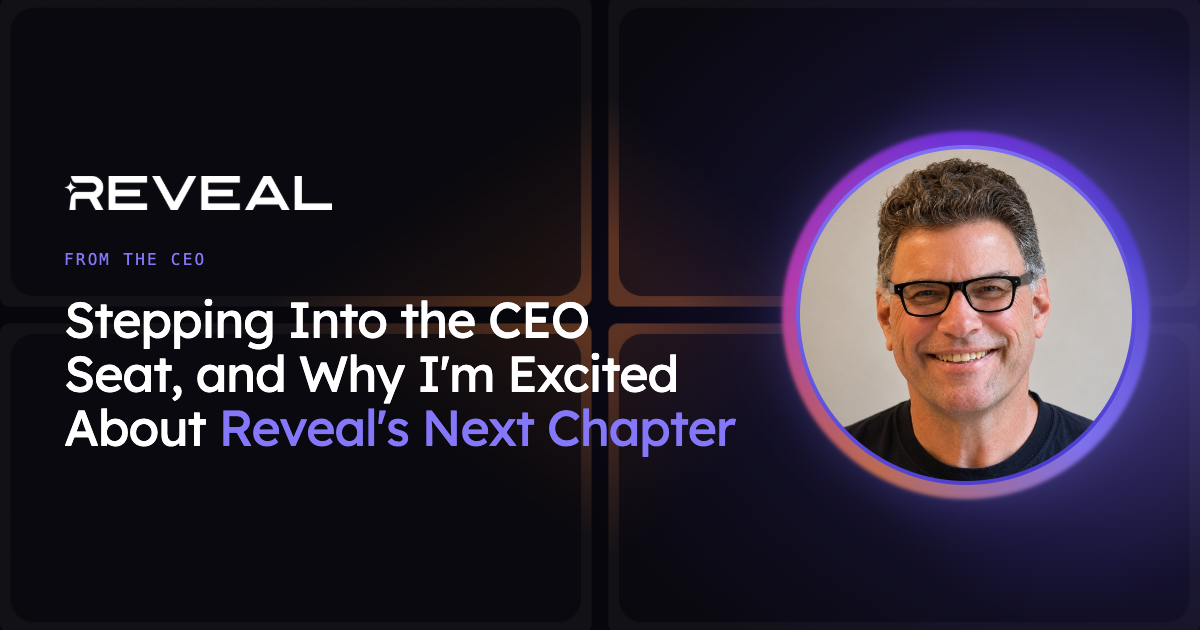
A note from Dave McKinley on taking on the role of CEO at Reveal Security, what it means to him, and where the company goes from here.
The reason I build products has never changed. I build them so people can actually use them, and so that someone sitting in front of what we made gets what I call the eyebrow moment, where their eyebrows crawl up their forehead and they say “oh my god, this is amazing.” Chasing that feeling is most of what has kept me in the builder’s chair all these years.
Today I am stepping into the role of CEO at Reveal Security, and I could not be more excited to do it. I came up through product & engineering rather than sales, and I have spent enough time close to the work to know the difference between tooling that helps and tooling that just adds noise. That history is why I will never tell you our product does something it does not do. I want you to value what we bring you right now, and to be just as excited as I am about where we are taking you next.
What changed, and why Reveal was built for it
I have been in cybersecurity long enough to remember when insider threat was an afterthought, something nobody wanted to fund because the firewall was supposed to have it covered. That has shifted radically in the last year, and the reason is straightforward. Your humans have always been your insiders, and now those same humans want AI, which they will get one way or another. Once that happens, AI becomes your insider too, and that is not something an endpoint or a firewall was ever built to see, because what you are dealing with is behavior.
This is the part I am proud of. Reveal was built for exactly this, years before the rest of the market arrived. We grew out of a desire to track behavior across many applications and across days at a time, which is why we talk about journeys rather than sessions. This is why we focus on where behavior deviates and whether that deviation matters for security. When a person authorizes any AI to act on their behalf, that agent behaves quite differently than the human would. On the surface it can look like a human is running the show. We can tell the difference, and finding exactly that kind of security relevant deviation has been the mission since day one.
Helping teams adopt AI without flying blind
In a nutshell, Reveal exists to let CISOs and their organizations give employees the freedom to adopt AI safely, and to give security teams the confidence that they will see it the moment something goes sideways.
That matters because most of the time when something goes wrong, it is not malice. It is someone enthusiastic about doing good work with a powerful new tool, and the human who pushed the button to let that AI in. If that agent drifts, you want to know before any damage is done. When a security team can count on taking action that early, the whole posture changes. You can support rather than slow down the tools your people are excited about, because you are no longer guessing about what happens once they are in motion.
That is the promise I care about most. To the teams carrying this every day, the message is simple: we’ve got you.
What I’m most excited to build next
We move fast, so I try not to over-predict, but a few things close at hand have me genuinely excited. The first is identity parentage across an organization. Instead of only reading your Okta or Entra, we look across all of your data sources so we can take an identity that has no obvious link back to its parent human and connect it anyway. Getting that into people’s hands is going to be a really cool thing.
I am just as excited about how deeply we connect into the rest of your environment, and our ability to plug into effectively anything that produces an identity signal. That includes the big, awkward legacy systems you cannot simply switch off, like a database that has run for twenty years and carries billions in revenue. If it throws off an identity signal, we can stitch it in.
Being able to walk into a large organization that is wrestling with those big, gnarly legacy problems and its modern tooling at the same time, and tell them we can cover both, is something I am genuinely looking forward to. The original Reveal product was built to handle exactly that kind of problem, and we are building on that foundation, and on the patent the company was founded on, to make it faster and more capable.
This is where I have landed as I step into this role. We are standing on a foundation that was built for this problem years before the rest of the market arrived, and now we are putting it to work for the people who need it most. For the security teams and organizations who want to embrace AI without lying awake at night, this is the kind of challenge I have spent my whole career building toward. I think it is going to be a lot of fun, and I could not be more excited about where we take Reveal from here. We’ve got you.