One thing that has stood out to me over the years working around identity and security operations is how disconnected the two functions still are. IAM teams and SOC teams are often solving pieces of the same problem, but from completely different angles. IAM focuses on access, governance, policy, and lifecycle management. The SOC focuses on alerts, investigations, incidents, and response. Both are critical. But the operational gap between them creates friction, and that friction is exactly what attackers have learned to exploit.
The reality we are starting to understand is that most modern attacks are identity-driven. Attackers are not smashing through firewalls or dropping obvious malware anymore. They are using compromised credentials, valid sessions, abused permissions, OAuth grants, service accounts, and trusted access paths. From the attacker’s perspective, identity is the easiest way to inherit trust inside an environment.
Which means identity is no longer just an IAM problem. It is an operational security problem. And the moment you accept that, the wall between SOC and IAM stops looking like an org chart and starts looking like a gap an attacker can walk through.
The issue is that most organizations still operationalize identity and security separately. I have seen SOC teams escalate activity because it looked suspicious, only to learn later it was expected business behavior. I have seen IAM teams identify excessive privilege or risky access patterns that never made it into operational detection workflows. Both sides usually hold valuable context. Very rarely does that context exist in the same place at the same time. And that creates a lot of inefficiency.
Identity Data Exists Everywhere, But Operational Context Doesn’t.
Most organizations are not lacking identity data. Authentication logs, access reviews, role assignments, entitlement systems, PAM tools, SaaS audit logs, endpoint telemetry, cloud identity providers, and SIEM data are all generating information constantly.
The problem is that none of these systems was built to tell a unified operational story. They were built to record, not to explain. A SOC analyst investigating suspicious activity often has to go find context that another team already holds:
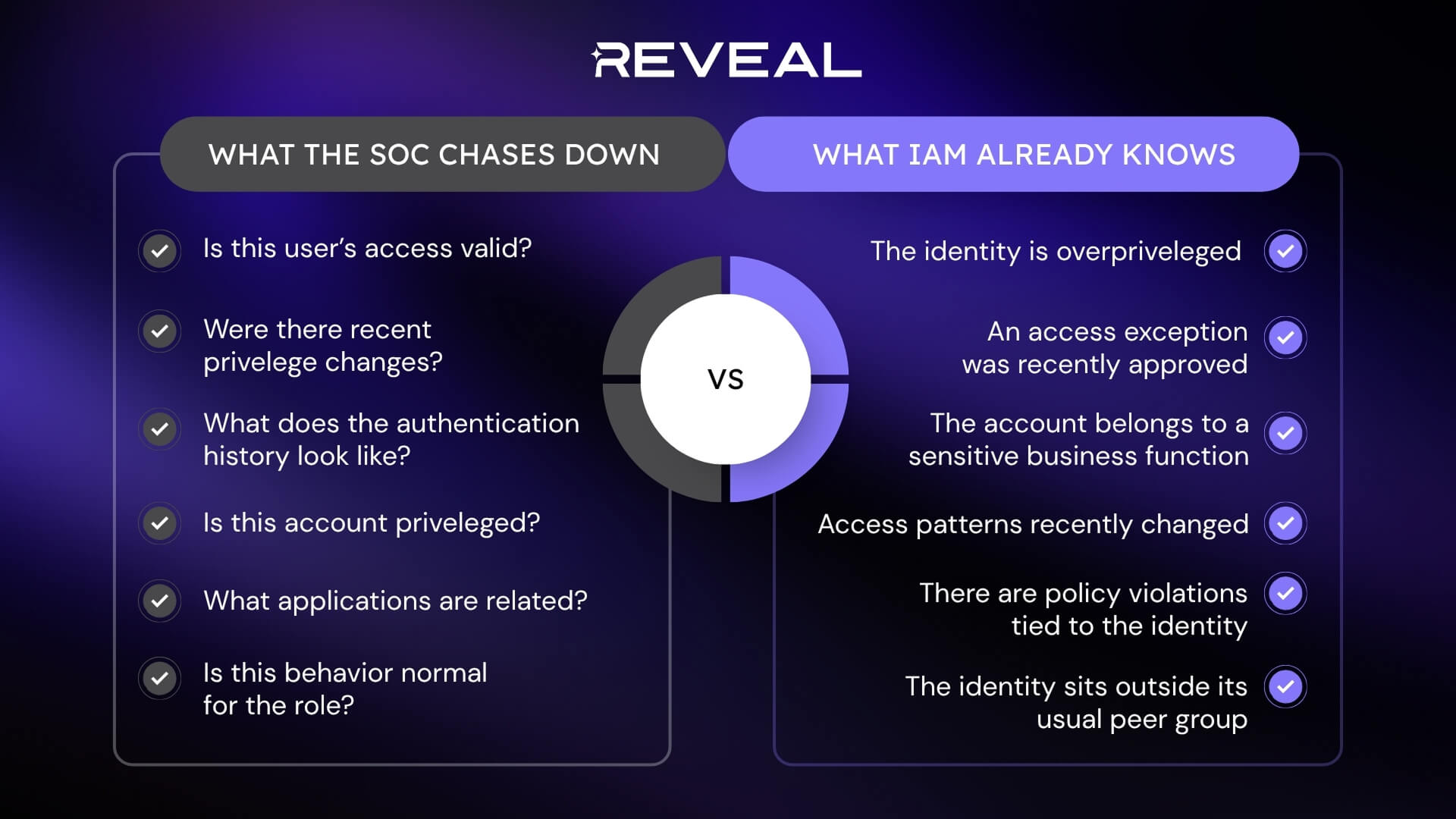
In most environments, those two columns live in separate tools and separate workflows. So every investigation becomes manual correlation: stitching the timeline together by hand, taking valuable time that an attacker is free to keep using.
What is missing is not more telemetry. It is operational identity visibility: the ability to connect identity posture, access, and activity into a single picture that makes an investigation faster and more accurate. You cannot defend against what you cannot see, and most teams today are seeing fragments.
Most Security Alerts Lack Identity Understanding
One thing I have learned is that unusual does not inherently mean dangerous. Security tools are very good at detecting activity they know how to look for. They are much less effective at understanding intent or operational context.
- A login from a new location might be risky. Or someone is traveling.
- A spike in activity could indicate compromise. Or it is quarter-end reporting.
- A developer accessing a sensitive system could be lateral movement. Or it is part of a deployment.
Without identity context, it becomes incredibly difficult to prioritize what actually matters. The problem is that most SOC workflows still evaluate activity as isolated events instead of identity-driven behavior. But identities carry context that changes how an alert should be interpreted: role, privilege level, historical behavior, peer activity, business function, application sensitivity, exception history, device trust, and recent entitlement changes.
Honestly, I think this is one of the biggest operational gaps in security today. Organizations ingest massive volumes of identity telemetry into SIEMs and detection platforms, and very little of it gets operationalized in a meaningful way. The result is usually more alerts without better understanding. I call this Signal Dilution: the more raw signal you collect without context, the harder it becomes to find the signal that actually counts.
Identity Security Has Become an Operations Problem
For a long time, identity programs were centered on governance and compliance. Those things still matter. Access reviews, least privilege, and role hygiene are all part of a healthy program. But operationally, attackers move much faster than governance cycles. Identity attacks unfold at machine speed: token theft, MFA fatigue, session hijacking, privilege escalation, OAuth abuse, compromised service accounts, cross-SaaS lateral movement. These are active operational security problems, not policy violations waiting for the next quarterly review.
The issue is that many organizations still treat identity as an administrative control layer instead of a continuous operational signal. That model is becoming very hard to sustain in cloud and agent-first environments, where identity now sits at the center of nearly everything: SaaS applications, cloud infrastructure, remote access, APIs, machine identities, automation, and AI agents.
What makes this even harder is the rise of agentic identities. Many AI-driven agents behave non-deterministically, meaning the exact sequence of actions they take changes based on context, prompts, and available data. You are no longer monitoring only human behavior patterns. You are monitoring identities capable of taking thousands of actions across systems in seconds, often in ways that were not explicitly predefined. These agents authenticate with an employee’s credentials, inherit their permissions, and keep acting long after the login is over.
That is what makes the concept of an Agentic Insider so real. It is the same operational worldview that leads us at Reveal to think about AI as an insider threat: any authenticated identity acting inside your environment, human or agent, behaving in ways your existing stack has no model for.
Traditional IAM governance processes and manual SOC investigations were never designed for that level of speed, scale, or unpredictability. Which means security operations can no longer afford to treat identity as a separate discipline. Operationalizing identity means identity telemetry becomes part of near-real-time detection, investigation, and response, instead of living only inside governance processes. Because at this point, identity is effectively the control plane of the enterprise.
The Biggest Cost Is Still Time.
If I had to point to the most expensive part of identity operations, it would still be the amount of manual effort required to understand what is happening. Pull logs from one platform. Validate access in another. Check entitlement history. Correlate timestamps. Message another team. Wait for clarification. Rebuild the timeline by hand.
Even in mature organizations, a relatively simple investigation can consume significant time once all the systems and dependencies are involved. That operational drag adds up, not just in analyst fatigue, but in real risk exposure. Because every minute spent manually stitching identity context together is a minute the attacker keeps operating.
What is needed is faster correlation and identity-aware investigations that already contain the operational context analysts need to make decisions quickly. Not more disconnected alerts.
Final Thoughts
The future of identity security does not belong to IAM teams or SOC teams independently. The organizations that will be most effective are the ones that operationalize identity as a shared security function.
Because attackers already understand something many enterprises still struggle with operationally: identity is where trust lives. And once trust is compromised, most traditional security boundaries become much less effective.
The challenge now is not collecting more identity data or deploying more tools. Most organizations already have plenty of both. The challenge is turning identity context into operational security intelligence that helps teams understand risk faster, investigate more efficiently, and respond with confidence. Because identity security is no longer just about controlling access. It is about understanding behavior, operationalizing context, and reducing the time between detection and action.